Arizona petrified wood comes from trees that fell into ancient rivers about 225 million years ago and slowly turned to stone. Most of it sits in the high desert around Holbrook, where we live.
You can’t take any from Petrified Forest National Park. You can buy it legally in town, though, or even dig your own on private land a few miles from the park gate.
Below, we cover how the wood formed, what the colors mean, where collecting is legal and what a piece should cost.
What Is Arizona Petrified Wood?
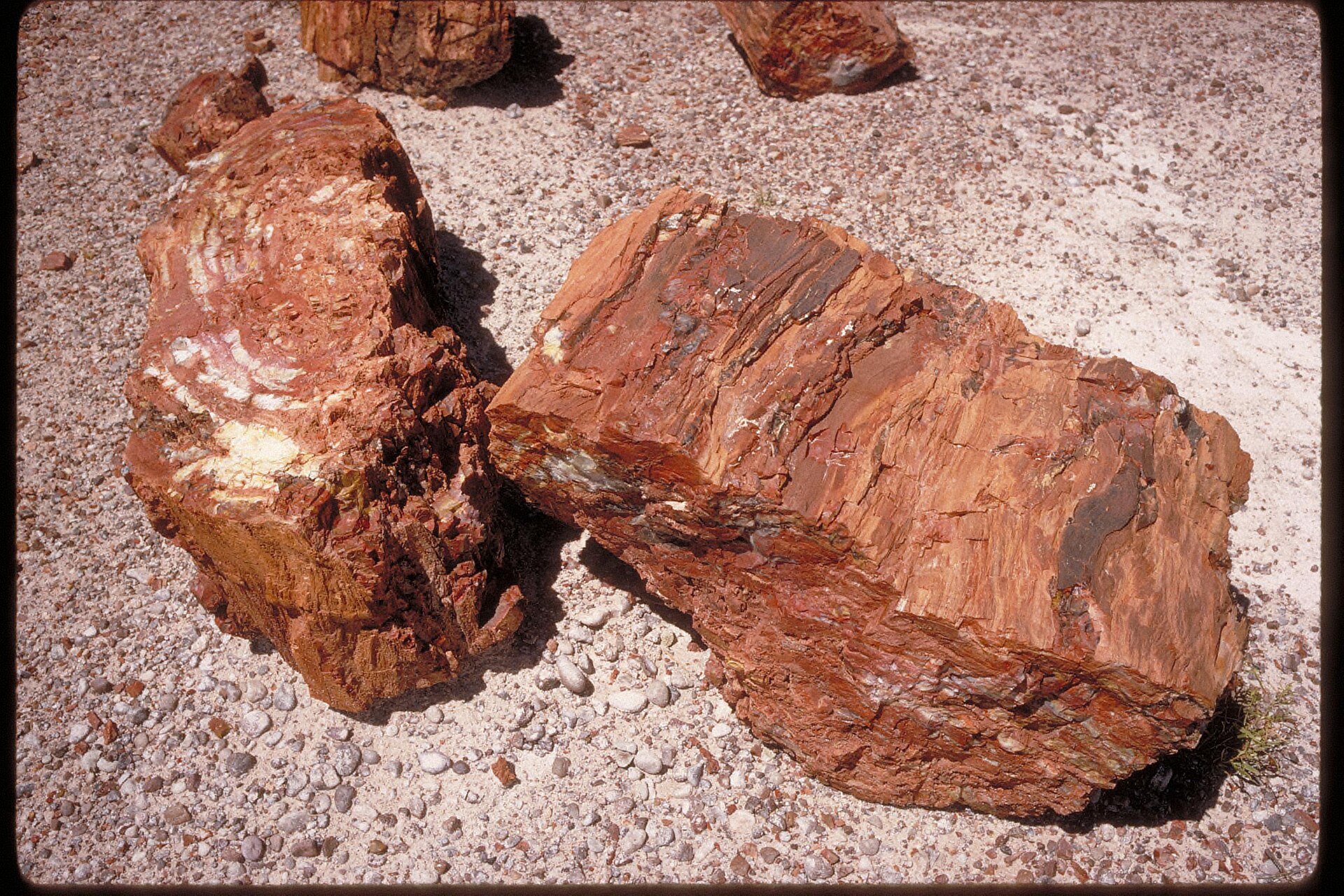
Petrified wood is a fossil. The tree’s shape survives, right down to the bark and the growth rings, but the wood itself has been replaced by quartz.
The National Park Service describes the logs as almost solid quartz. So a piece feels like a rock in your hand, because it is one.
Most of the wood here comes from an extinct conifer called Araucarioxylon arizonicum. In 1988, Arizona made petrified wood its official state fossil.
How Old Is It?
The logs date to the Late Triassic, roughly 225 million years ago. That’s older than most of the dinosaurs people picture.
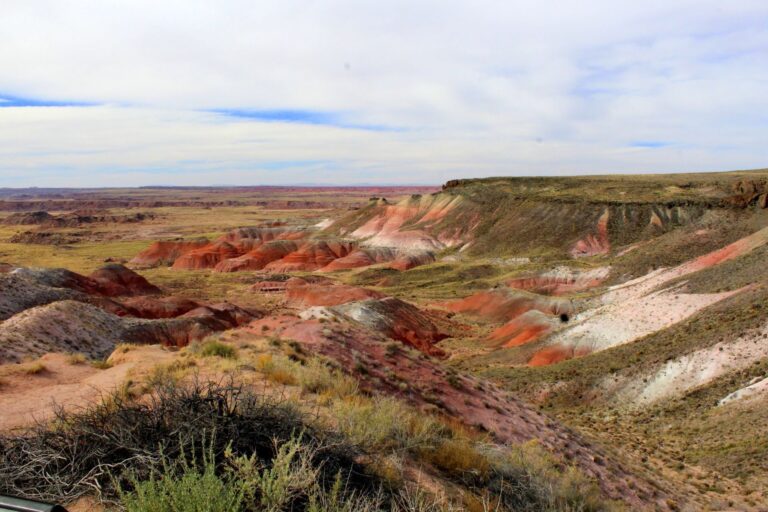
They’re buried in a rock layer called the Chinle Formation. That same layer paints the badlands of the Painted Desert in bands of red, purple and gray.
How a Tree Turns to Stone
First, the trees died and washed into a large river system. Then mud, sand and volcanic ash buried them fast, which cut off the oxygen that would have rotted them.
Next, groundwater carrying silica from that ash seeped into the logs. Over a very long time, the silica crystallized and took the place of the wood.
Later, about 60 million years ago, the land here began to rise. That stress snapped the buried logs like glass rods, according to the park.
That’s why so many logs look like someone cut them with a chainsaw.
Why There’s So Much of It Here
Arizona ended up with so much petrified wood because it had the right mix of big trees, fast burial and plenty of volcanic ash.
Then erosion uncovered the logs again.
Even so, the park only protects just over 20 percent of the original deposit. Much of the rest lies on private land around the park and Holbrook.
That’s the reason our rock shops have yards full of it. Finding petrified wood in this corner of the state isn’t rare at all.
What Gives It Those Colors?
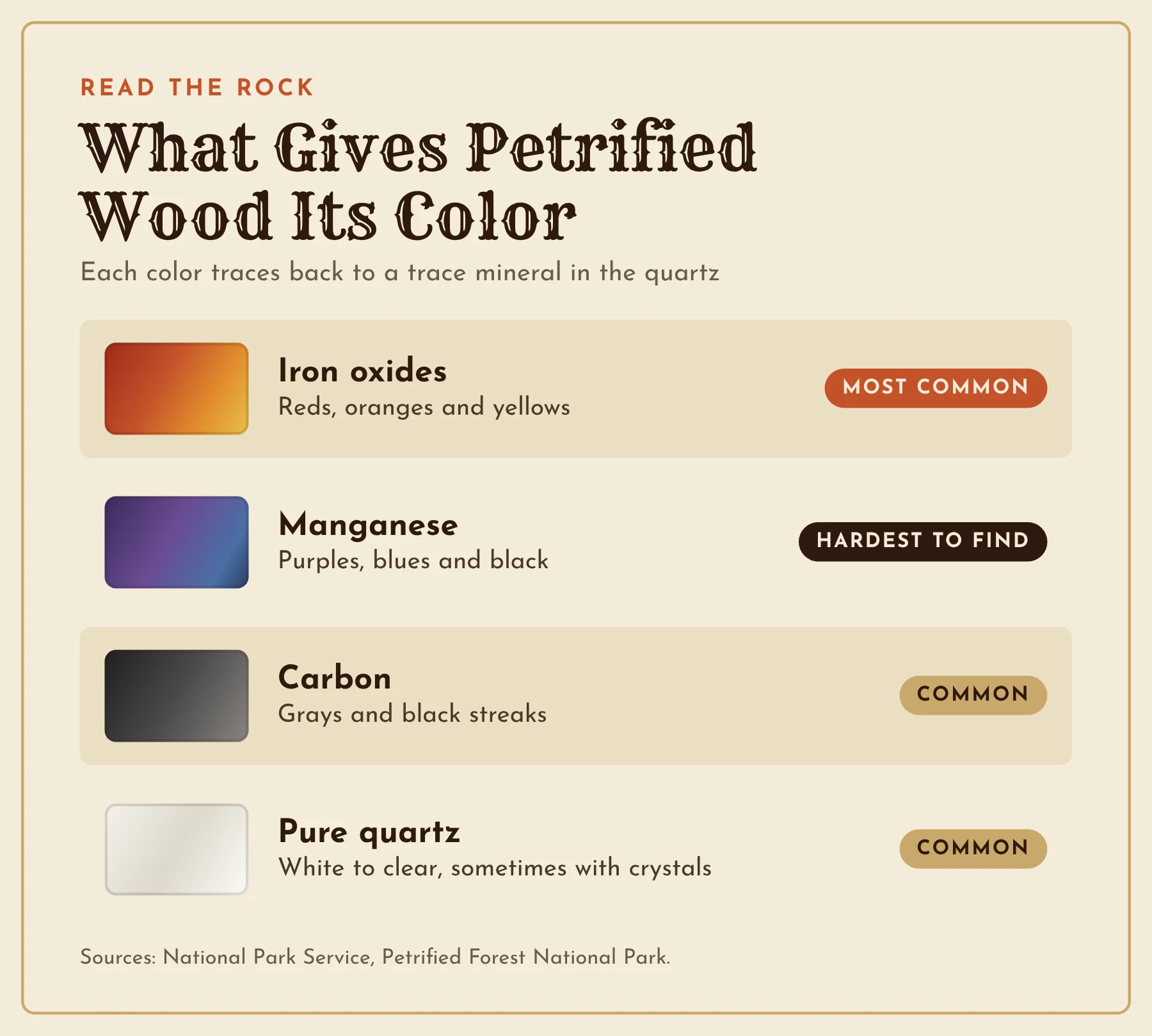
Pure quartz is white or clear. Everything else comes from trace minerals that rode along with the silica.
Iron oxides make the reds, oranges and yellows, while manganese adds purple, blue and black. Carbon, meanwhile, leaves gray and black streaks.
People sometimes ask which color is the rarest. Collectors and dealers usually point to blue and purple, since manganese turns up far less often than iron.
Is It Radioactive?
Usually, no. Some logs in this part of the country did soak up uranium, though, because the same rock layers hold uranium deposits.
In a 2020 study in Geosciences, geologist George Mustoe tested uranium-bearing fossil wood from mines and prospects in the West. One sample came from near Holbrook.
Still, he found gamma radiation levels were low in all of his specimens.
Petrified wood in a typical Arizona rock shop is ordinary colored quartz. If you’re curious about a piece, ask the shop where it was dug.
Can You Take Petrified Wood From the Park?
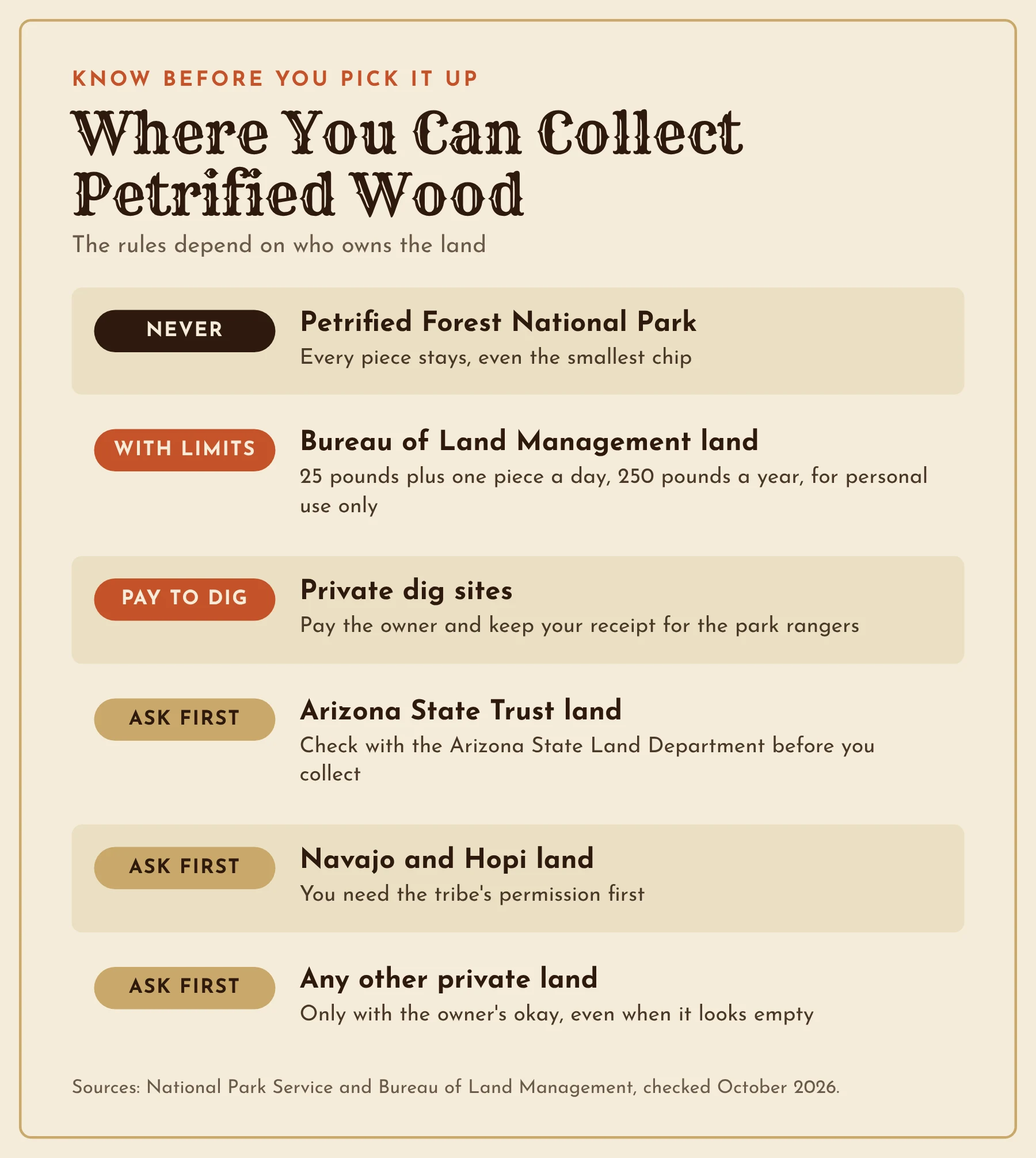
No. Taking anything natural from Petrified Forest National Park is against the law, including the smallest chip.
According to the Park Service, the park would be picked clean within a few years if collecting were allowed.
Before it was protected, it nearly was.
Railroads brought tourists in the late 1800s, and people hauled wood away by the wagonload. Locals got worried enough that the Arizona Territorial Legislature asked Congress for a park in 1895.
That first try failed. Then, in 1906, Theodore Roosevelt made it a national monument, and it became a national park in 1962.
What Happens at the Park Exit
Rangers at the entrance stations may ask whether you have any petrified wood in the car. If you bought some in town first, that’s fine.
Just keep your receipt. It shows the wood came from outside the park.
The Curse and the Conscience Letters
Some visitors pocket a piece anyway, and then their luck goes sour. Since 1934, the park has saved the letters people send back with stolen wood, and the archive now holds more than 1,200 of them.
They still arrive a few times a month. Ryan Thompson and Phil Orr collected some of them in a 2014 book, Bad Luck, Hot Rocks.
The rock comes back. It just can’t go home.
Returned wood can’t go back where it came from, because nobody knows exactly where that was.
Instead, it goes on a pile off a service road that visitors can’t reach.
You may also read online that 12 tons disappear from the park every year. However, when park staff compared more than 200 pairs of old and new photos, only one pair showed damage, according to Collectors Weekly.
Where You Can Legally Collect It
You have real options for collecting petrified wood in Arizona, but the rules change with the land.
Here’s the short version.
Digging Your Own at DoBell
DoBell Mineral and Excavations runs a dig site on Old US Highway 180, a few miles from the park’s south entrance. Its website says it’s open daily from 8 a.m. to 8 p.m.
They hand you a shovel, a pick and a five-gallon bucket. A visitor who wrote about it in 2022 paid $45 for a full bucket.
Bring water and sun protection, because the wind out there doesn’t quit. Also, ask for a receipt before you leave, for the same reason as above.
Prices and hours can change with the season, so call ahead before you make the drive.
Collecting on BLM Land
On most land the Bureau of Land Management runs, you can collect 25 pounds plus one piece a day. The yearly limit is 250 pounds.
The wood has to be for your own use, not for sale. Hand tools are fine, as long as you don’t dig up much ground. The BLM’s rockhounding page spells out the details.
Some BLM areas have their own rules, so check with the local office first.
State Trust and Tribal Land
Arizona State Trust land isn’t public land in the same way. Check with the Arizona State Land Department before you pick anything up.
Much of the land north of Holbrook belongs to the Navajo Nation. There, you need the tribe’s permission first, and the same goes for the Hopi Reservation.
Private land always needs the owner’s okay.
That’s true even when it looks empty.
Want to see how the logs formed before you go looking? This short PBS Terra video was filmed inside the park.
Where to Buy Arizona Petrified Wood in Holbrook
Holbrook is the closest town to the park’s south entrance, and the town has sold petrified wood for decades. If you want to take home a piece of Arizona petrified wood, these three shops are where we’d start.
Jim Gray’s Petrified Wood Co.
Jim and Cathy Gray started this place more than 50 years ago with a pickup truck and a pile of wood. Today it’s the big one, at 147 US Highway 180, right on the road to the park.
The family says it owns the mineral rights to several sections of land near the park. They dig, cut and polish their own wood, from small end cuts to full tabletops.
Inside, there’s a free fossil museum.
Look for Wild Bill, the fossil alligator skeleton on the billboards out front.
The store opens at 8 a.m. daily and closes at 6 p.m. in winter and 7 p.m. in summer. Read more on our Jim Gray’s page.
Rainbow Rock Shop
You’ll know this one by the dinosaurs. Adam Luna started building them in 1986 at 101 Navajo Boulevard, and the tallest stand 25 feet high.
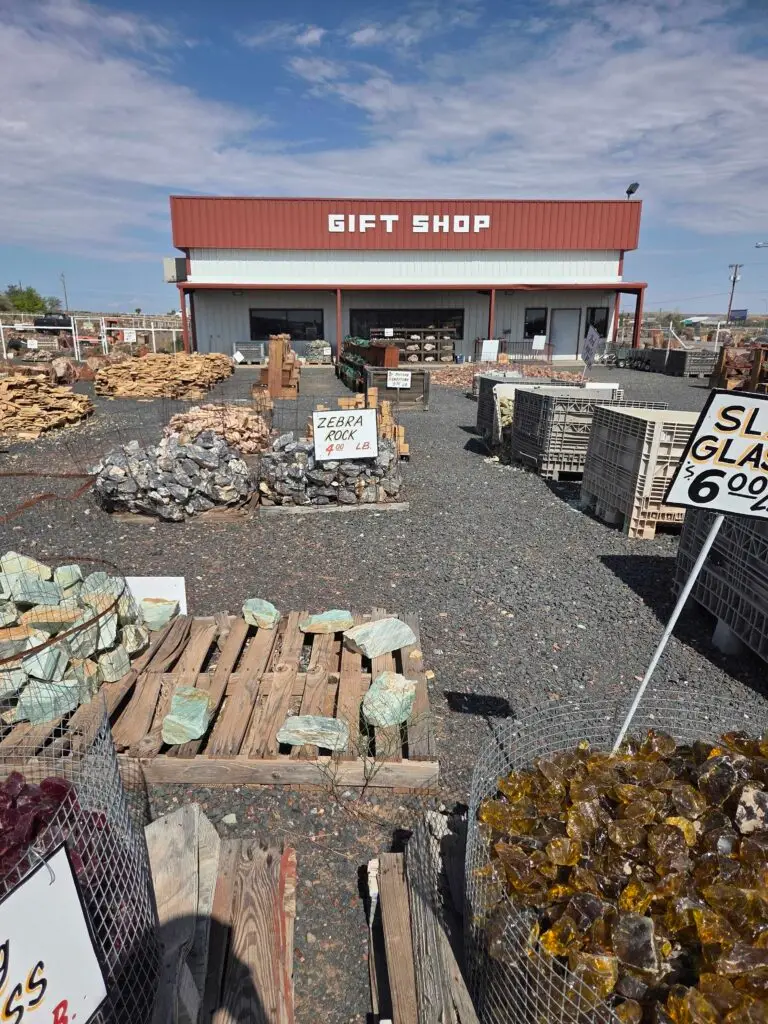
Raw petrified wood sits right among the dinosaurs out front. Inside, the shop sells pieces cut and polished on saws Adam built himself.
The shop keeps unpredictable hours, but the dinosaurs are always there for a photo.
Just don’t climb on them, because the signs mean it.
Stewart’s Petrified Wood
Stewart’s sits 13 miles east of town at I-40 exit 303, so it’s an easy stop on the way to or from the park. Look for the homemade dinosaurs you can see from the interstate.
Charles Stewart opened the shop in 1994, and the family has kept it going since he retired. Over the years it’s been known for its ostriches and for giving every kid a free piece of wood.
Call before you go, since roadside shops out here can change their hours.
Petrified Wood Around Town
The stone shows up in Holbrook in other places, too. In our old cemetery, some graves are marked with petrified wood, next to hand-poured concrete headstones.
If you’re staying a night to see all of this, compare our picks for the best places to stay in Holbrook.
What Petrified Wood Costs
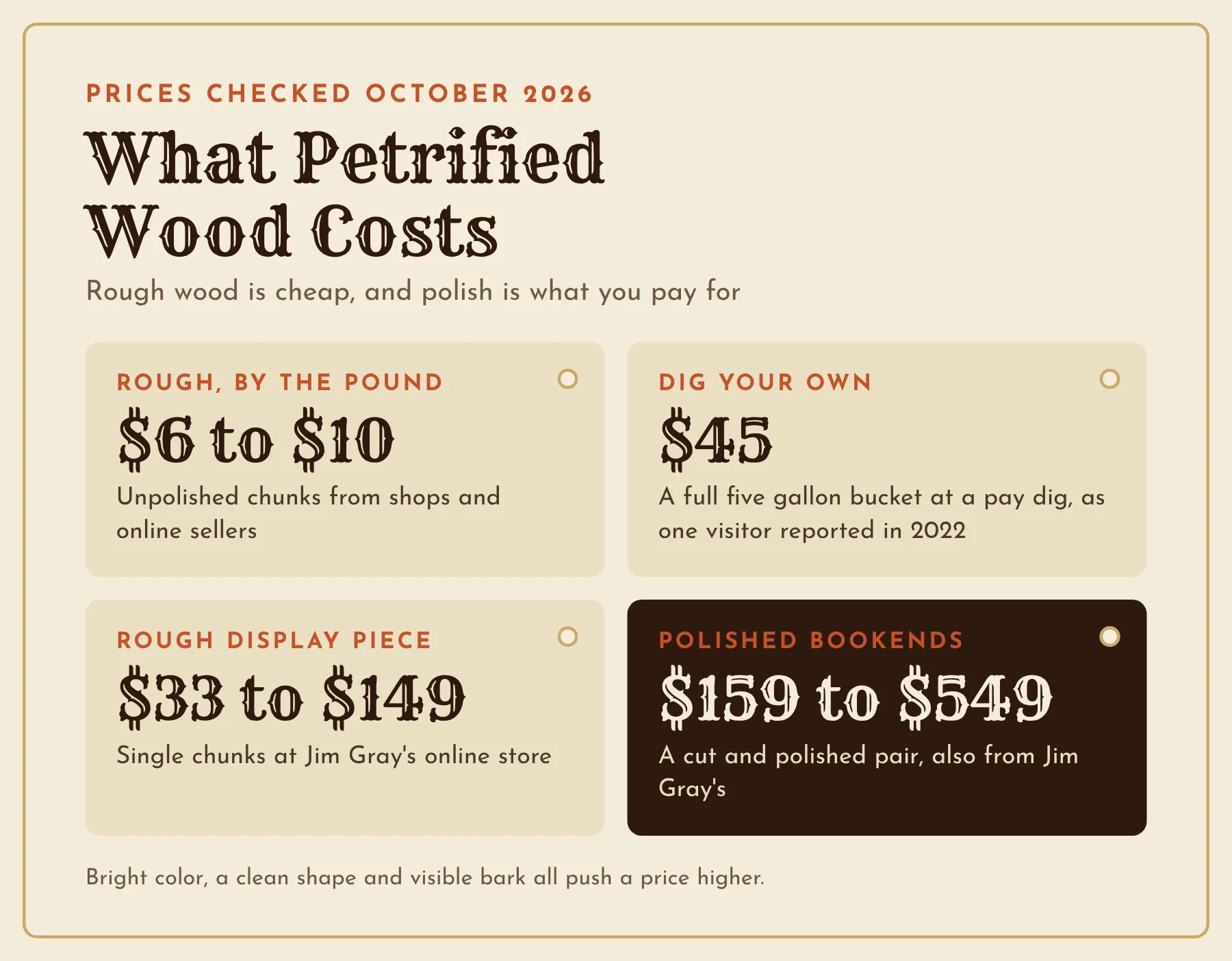
Price depends on three things: color, size and how much work went into it. Rough wood is cheap, while polished pieces cost far more.
Is Arizona Petrified Wood Worth Anything?
Yes, though most petrified wood from Arizona won’t make you rich. Rough wood usually sells for about $6 to $10 a pound, based on what a few shops and online sellers were asking in October 2026.
So a 10-pound rough piece might bring $60 to $100. Bright color, a clean shape or bark you can still see push that higher.
Cutting and polishing change the math. Jim Gray’s online bookends ran from $159 to $549, and full rounds and tabletops cost more than that.
If you want to sell a piece, expect less than retail. Shops have to buy low enough to cut, polish and resell it.
How to Pick a Good Piece
Look at the color first, because that’s what you’ll enjoy on a shelf. Rich reds, yellows and a bit of purple usually cost more than plain brown and gray.
Next, check for cracks. Polished pieces should be glassy all the way across, without dull spots.
Finally, ask where it was dug. A good shop will tell you, and it should hand you a receipt without being asked.
Is It Worth the Trip?
If you’re driving out to see the park, give the shops an hour too. Seeing the logs in the park and then holding a polished slice in town makes the whole story click.
Our Petrified Forest guide covers the trails and stops inside the park. For the rest of your visit, tell us your dates, and our free trip planner will build your Holbrook stop for you.